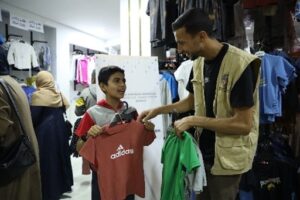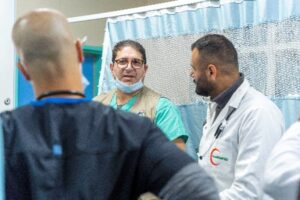
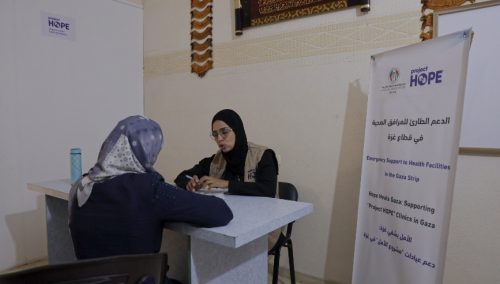
The humanitarian crisis in Gaza has severely disrupted access to healthcare services. Damage to health infrastructure, population displacement, and increased demand for emergency services have placed enormous strain on the healthcare system.
In southern Gaza, where large numbers of displaced people have sought refuge, primary healthcare services serve as the first and often only point of care for many communities. Clinics provide essential services ranging from basic medical consultations to maternal health support and psychosocial care.
Primary healthcare facilities are therefore essential not only for treating common illnesses but also for preventing disease outbreaks, supporting maternal and child health, addressing trauma-related mental health needs, and providing protection services for vulnerable populations.
Project Objectives
The overall Objective of this project is to strengthen access to essential primary healthcare services for displacement-affected communities in southern Gaza.
Specific Objectives
- Support the operational capacity of primary healthcare centers through the deployment of healthcare workers.
- Ensure continuity of essential primary healthcare services for displaced populations.
- Provide integrated health services including medical care, psychosocial support, and protection services.
- Strengthen community health awareness and preventive care activities.
Geographic Coverage
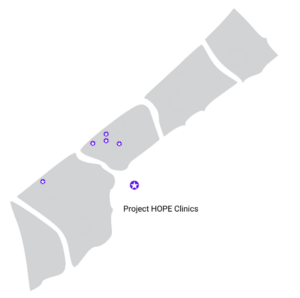
The project supports five primary healthcare clinics operated by Project HOPE across Khan Younis and Deir Al-Balah, areas hosting large populations of displaced families.
These clinics serve as essential healthcare access points for thousands of people who rely on primary health services for routine medical care, maternal health support, and psychosocial services.
Target Beneficiaries
The supported services reached women, men, and children, with particular attention to vulnerable populations, including:
- children and adolescents, through nutrition screening, protection services, and health awareness activities
- women, through sexual and reproductive health services, maternal care, and GBV response
- displaced families, requiring integrated medical, psychosocial, and protection support
By integrating medical care with psychosocial and protection services within a primary care model, the project helps address both immediate health needs and the broader well-being of communities affected by displacement and crisis.
Key Activities
Deployment of Healthcare Workers
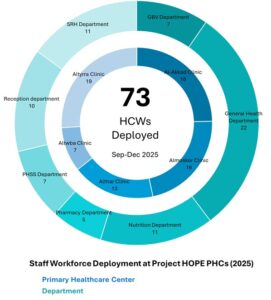
To sustain clinic operations under crisis conditions, PAMA deployed 73 healthcare workers across multiple departments within Project HOPE primary healthcare centers. These health workers supported daily operations and helped ensure the continuity of services despite increased demand and challenging operational conditions contributing to a total of 4,859 working days. Healthcare teams supported services across multiple departments, including:
- general outpatient consultations
- nutrition screening and support
- sexual and reproductive health services
- mental health and psychosocial support (MHPSS)
- gender-based violence (GBV) response services
- child protection services
- community awareness and health education activities
Service Delivery Impact (2025)
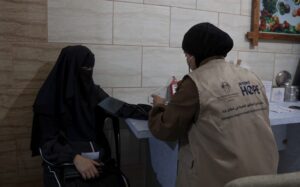
During 2025, the deployment of healthcare workers supported the delivery of healthcare services across multiple departments, reflecting the breadth and scale of health needs addressed through primary healthcare in displacement-affected communities.
237,280 primary healthcare services